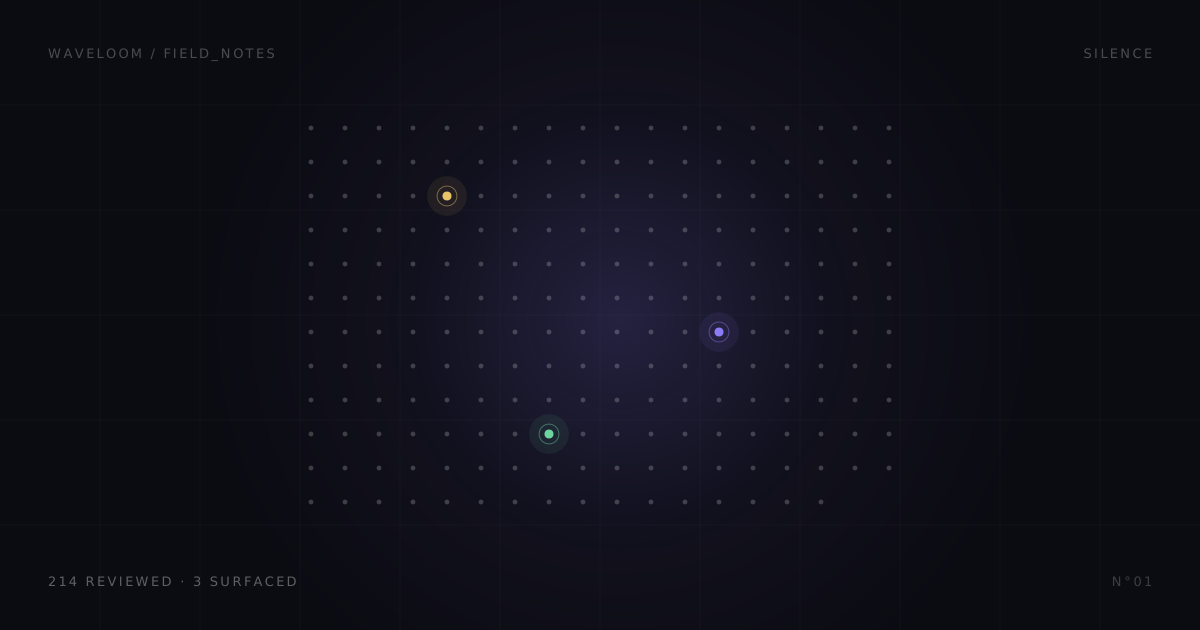
Waveloom reads my Gmail, my Slack, my Notion, my Linear, my HubSpot and my calendar. It follows a handful of web watches. On a normal day it looks at a few hundred things.
On a normal day it shows me three or four cards.
The gap between those two numbers is the product. Everything else is plumbing.
Every notification product drifts toward noise
I do not think anyone sets out to build a noisy product. It happens anyway, and it happens for reasons that have nothing to do with the user.
The first reason is incentives. If your metric is engagement, every notification is a small win. Opens go up. Sessions go up. Nobody in a growth review has ever been asked to justify sending fewer notifications.
The second reason is asymmetry. Adding a card is easy. Someone asks for it, you ship it, they are happy. Removing a card is hard. Somebody, somewhere, relies on it. You cannot prove what the silence would have been worth. So cards accumulate and nothing is ever taken away.
The third reason is that AI makes it worse, not better. A model can find something interesting in almost anything. Ask it whether an email matters and it will produce a confident paragraph about why it might. If you build the system to surface whatever the model finds interesting, you have built a machine for generating plausible reasons to interrupt you.
I know this because I built that machine, twice, before this version.
What earning trust through silence means
Here is the standard I hold Waveloom to. If it interrupts you, it should be right. If it is not sure, it should say nothing. And it should be not sure most of the time.
That last part is the hard one. It is easy to build a system that is cautious on paper and chatty in practice. The prompt says "only surface important items" and the model surfaces twelve a day, because twelve things looked important to a model that has never met you.
A prompt is a suggestion. Over enough runs, a suggestion drifts. So the rules that keep Waveloom quiet are not in the prompt. They are in the code, and the model cannot argue with them.
The mechanisms, specifically
A confidence bar that drops rather than queues. Incoming items are processed in small batches, and each item gets a confidence score. Below the bar, the item is dropped. Not queued for later, not parked in a "maybe" list. Dropped. A maybe list is just a feed with a delay.
No-op when confidence is low. If a batch ends without confidence that something needs you, the result is a no-op. No card, no notification, no draft. The no-op is the most important outcome in the system and it fires more often than any other.
Rate caps. There is a hard cap on how many cards a batch can create and how many notifications can go out per day. If the cap is hit, the next item waits or is dropped. A busy inbox does not earn a busy feed.
One card per topic. A topic that already has a card doesn't get a second one; new events on it join the existing card's thread. Five emails about the same partnership become one card with a thread, not five cards.
Quiet hours. You set them. During quiet hours nothing pushes to you. The feed is still written, so nothing is lost. You see it when you choose to.
None of these can be talked out of by the model. They are not tone. They are not personality. They are limits.
The honest counter-point
Silence has a cost, and I want to be direct about it.
Silence only works if the few things it does surface are right. A quiet feed with a wrong card is worse than a noisy one, because you have nowhere else to look. You trusted it to filter and it filtered wrong.
The second problem is that silence looks like failure. A feed that shows nothing for six hours is indistinguishable from a feed that has stopped working. Every quiet product I have used made me wonder if it was still on.
So Waveloom shows its work. At the top of the feed you can see the counts: reviewed N items, surfaced M. When it is quiet you can see that it reviewed 214 things overnight and surfaced two, to pick illustrative numbers. When it shows nothing, you can see it looked. The morning brief is separate: a short summary of what was surfaced, one priority, and a note from the agent, and it is skipped entirely on a night when there was not enough to say.
The counts also keep me honest. If surfaced items climb and the ratio of approved to dismissed drops, the threshold is wrong and I raise it. The target I am tuning toward is a few meaningful cards a day, not a full screen.
What this looks like in practice
A morning brief, once a day, when there is something to put in it. Two or three cards that need you, usually with a draft reply attached that you can edit, approve, or throw away. Maybe one discovery from a watch. That is the whole day, most days.
Nothing gets sent without your approval. Nothing irreversible happens on its own. And most of what Waveloom sees, it decides not to mention.
That decision, made hundreds of times a day, is the product.
The thresholds, what counts as the same topic and what counts as "enough confidence" are what I am tuning with the beta cohort right now. I would rather do that with a few people who will tell me when a card should not have appeared than with a crowd that never opens the feed.